
Yancey County Clerk Office
The Yancey County Clerk of Superior Court is John Robinson, according to the county government courts directory. North Carolina does not split local trial-court files between a county clerk and a district clerk. The Clerk of Superior Court keeps the court records for both Superior Court and District Court and is the office NC Courts points users to when they need paper files, certified copies, public terminal searches, or case-file help for a matter filed in Yancey County.
The office is in Room 5 of the Yancey County Courthouse on Burnsville's Town Square. The same courthouse complex is also important for payments, court dates, magistrate contact, and probate work. The Register of Deeds is nearby in Room 4, but that office handles marriage licenses, land records, and vital-record copies rather than divorce judgments, criminal files, civil case files, or probate court files.
Yancey County Clerk of Superior Court
Clerk: John Robinson
110 Towne Square, Room 5
Burnsville, NC 28714
828-678-5700
Monday-Friday court-office visits should be verified before arrival
The official Yancey contact directory is the source for the local clerk, magistrate, District Attorney, judge, Guardian ad Litem, and arbitration phone listings. That directory helps separate court-record questions from prosecution, magistrate, and program contacts.
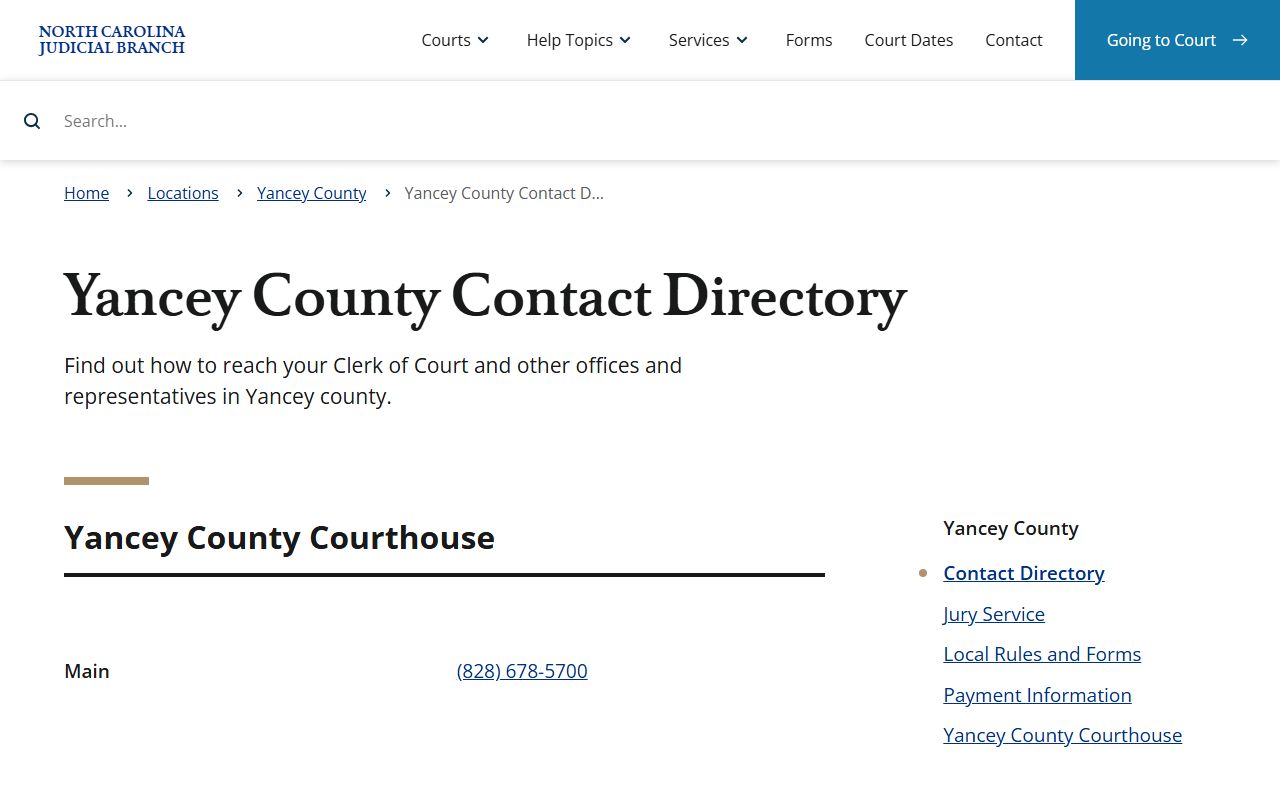
The directory confirms that the Clerk of Superior Court is the local court-record contact, while other court officials have separate numbers for their own roles.
Yancey County Clerk Duties
The Clerk of Superior Court performs clerical and recordkeeping functions for both trial-court levels in Yancey County. NC Courts explains that clerks keep records, manage case files, collect court money, support calendars, and perform probate-judge duties for estates and many special proceedings. The clerk also provides the in-person fallback when Portal results are incomplete, older paper records are needed, or a certified copy must carry an official seal.
For criminal case information, NC Courts says a public self-service terminal at a clerk's office may be searched by defendant name, case number, or victim or witness name. Civil, special proceeding, and estates searches can also use the terminal route. Paper files and copies must be handled in the county where the case was filed, so a Yancey case that cannot be resolved online comes back to the Yancey County Clerk of Superior Court.
- Maintains Superior Court and District Court case files, indexes, dockets, and public terminal access.
- Issues plain copies, certified copies, certificates under seal, and exemplified records when available.
- Collects court costs, fines, fees, and eligible traffic payments through approved payment channels.
- Acts as probate judge for estates, guardianships, and many special proceedings.
- Directs users to NCAOC only for Judicial Branch administrative records, not county case files.
Request Yancey Certified Copies
Certified copies are used when a court document must be proven as an official copy, such as a judgment, divorce decree, estate order, or other filed paper. Online case details are useful for lookup, but they are not a substitute for a certified copy from the office that holds the file. For Yancey County court files, identify the case first through Portal, the hearing search, or the clerk's public terminal, then request the document from the Clerk of Superior Court.
- Search the NC eCourts Portal or clerk terminal for the case number, party names, filing county, and document name.
- Confirm that the file is a Yancey County Superior Court, District Court, estates, or special proceeding file.
- Contact the Clerk of Superior Court at 828-678-5700 or visit Room 5 to confirm copy availability and cost.
- Pay the copy and certification charges using the payment methods the clerk accepts for that service.
- Ask whether the copy will be plain, certified under seal, or exemplified if another court or agency requires that form.
Note: Certified court copies must come from the clerk's office that holds the Yancey County case file.
Yancey Records Request Fields
The research did not locate a separate Yancey-specific web form for certified court copies. The practical request still needs the same core fields because the clerk must locate the right case and document before quoting or issuing copies. More detail reduces the chance of a wrong case match, especially when names are common or the searcher does not know whether the matter was filed in Superior Court, District Court, estates, or special proceedings.
| Field | Needed | Yancey County Notes |
|---|---|---|
| Case number | Best if known | Portal case numbers may use a two-digit year, case-type letters, sequence number, and county identifier. |
| Party names | Yes | Use full names and role if known, such as defendant, plaintiff, petitioner, respondent, decedent, or estate. |
| Document type | Yes | Examples include judgment, order, divorce decree, letters testamentary, disposition, or docket entry. |
| Filing county | Yes | Paper files are handled in the county where the case was filed, so identify Yancey County. |
| Copy type | Yes | Plain copy, certified copy, certificate under seal, or exemplification may have different costs. |
| Return method | As arranged | Ask the clerk whether pickup, mail, or another method is available for the requested record. |
Yancey County Clerk Fees
The 2026 North Carolina court cost charts provide the copy, certification, search, filing, and court-cost figures used by Yancey County court users. A copy request may involve more than one charge. For example, a certified judgment can include page copy charges plus a certificate under seal, while a new civil filing may include both filing costs and sheriff service costs if service is requested through the sheriff.
| Item | Fee / Cost |
|---|---|
| Court copies | $2.00 first page of each document, $0.25 each additional page |
| Certificate under seal | $3.00 |
| Exemplification of records | $10.00 |
| Criminal record search | $25.00, subject to listed exemptions |
| Magistrates' Court civil filing total | $96.00, plus $30.00 sheriff service per item if served |
| District Court civil filing total | $150.00, plus $30.00 sheriff service per item if served |
| Superior Court civil filing total | $200.00, plus $30.00 sheriff service per item if served |
| Absolute divorce filing | $75.00 |
Yancey Clerk Payment Channels
Yancey County payment rules are specific. Mail payments must be money order or certified check only; cash and personal checks are not accepted by mail. Payments should be payable to Yancey County Clerk of Superior Court and mailed to Clerk of Superior Court, Yancey County Courthouse, 110 Town Square, Room 5, Burnsville, NC 28714. If the payment is for an eligible traffic citation, include the citation number.
In-person payments at the Cashier's Office in the Clerk of Court's office may be made by cash, credit or debit card with processing fees, money order, or certified check. Personal checks are not accepted. Online payment is available for eligible matters by credit or debit card with processing fees. These rules matter because an otherwise valid payment can be delayed if it uses a method the clerk does not accept.
Yancey Local Forms
Yancey County's NC Courts local rules and forms page lists local materials rather than a county-built court-record request form. The research found local rules, a pretrial release policy, an administrative order about search warrants by two-way video conference, and a local custody-action form. Statewide forms, such as divorce packet forms and estates forms, are maintained by the Judicial Branch and are used with the clerk when the filing type requires them.
- Yancey local rules and forms for local policies and county-linked forms.
- North Carolina divorce packet for absolute divorce forms and filing steps.
- North Carolina estates help for probate forms, estate filing basics, and clerk procedures.
The statewide separation and divorce resource explains that divorce judgments are court records obtained from the clerk where the divorce was granted. That is why Yancey divorce decrees route to the Clerk of Superior Court rather than the Register of Deeds.
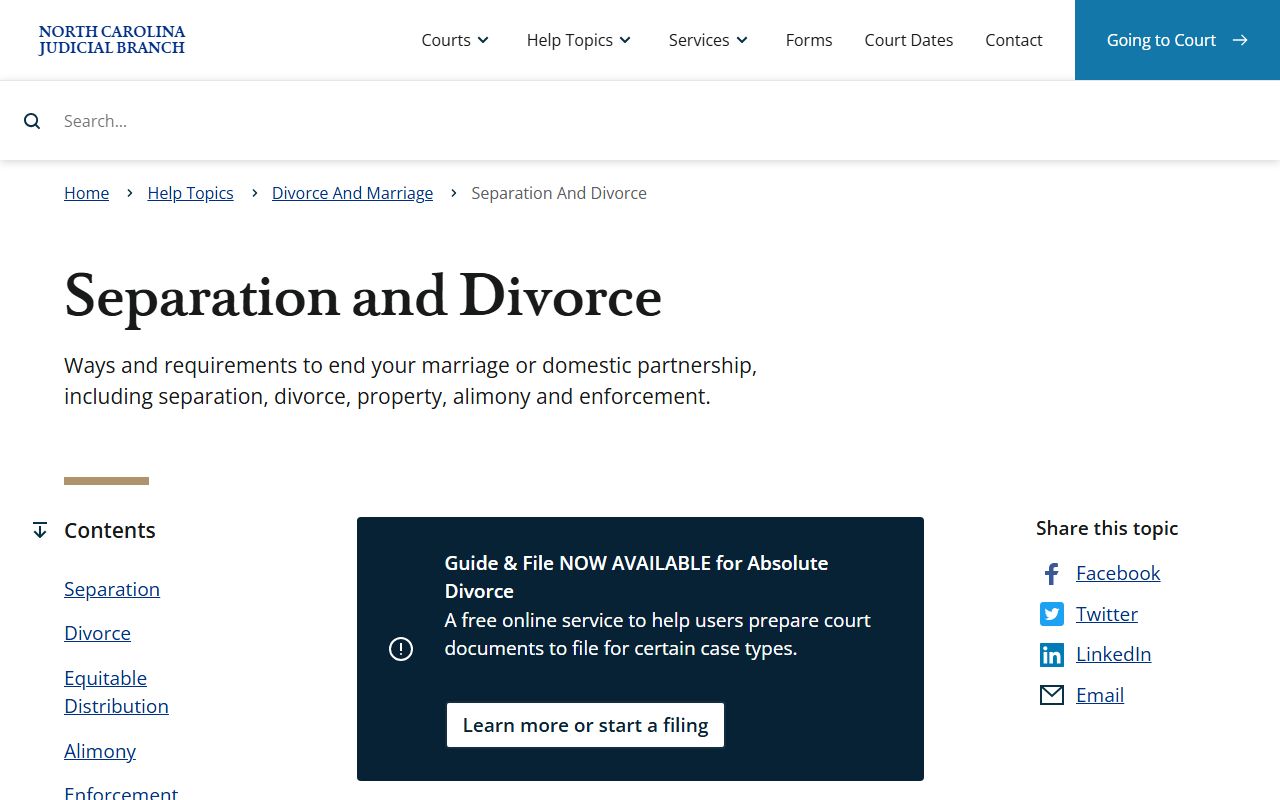
The statewide divorce material supports the local rule: marriage records and divorce judgments are held by different Yancey County offices.
The North Carolina divorce packet lists forms used when a filer seeks an absolute divorce without asking for alimony or property division. Those forms are filed through the court system, so the clerk is the local filing and record contact.
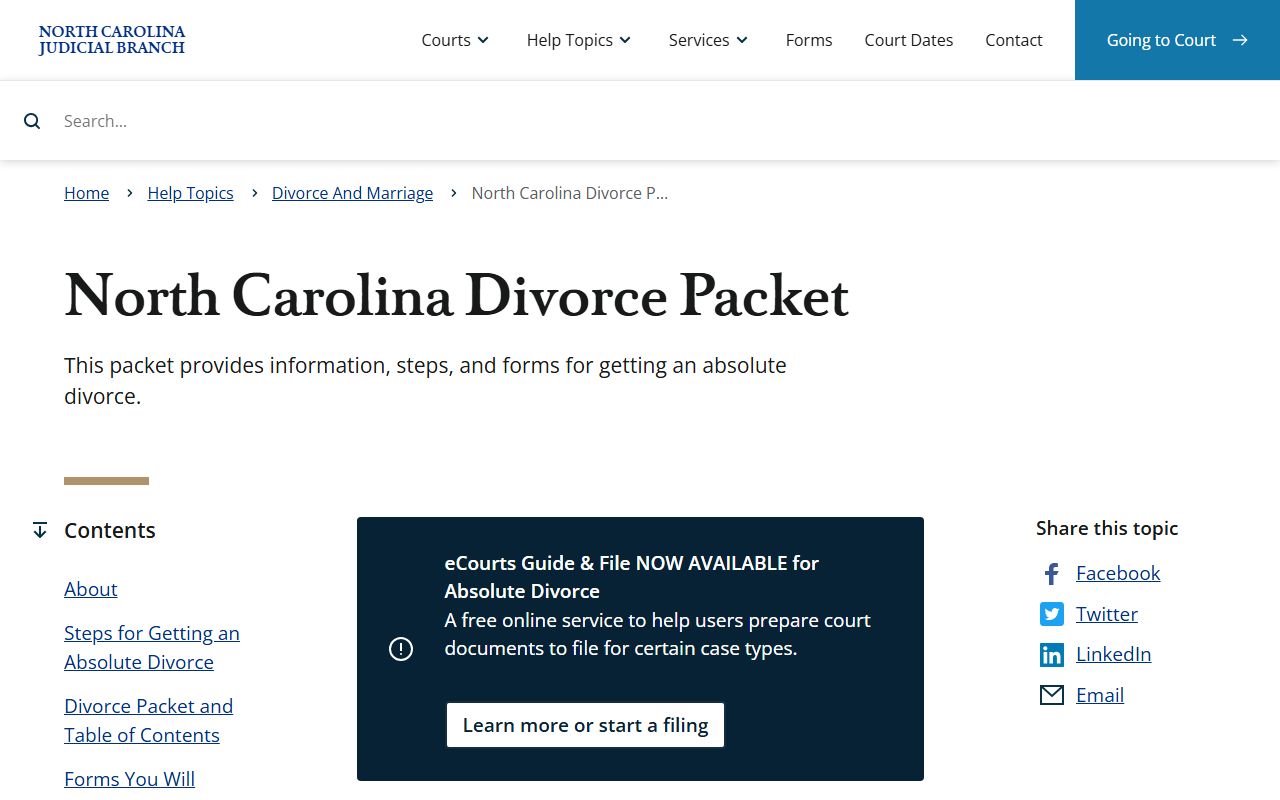
The packet also shows why service, hearings, and judgment entry become part of the court file instead of the vital-record file.
Confidential Clerk Records
The Clerk of Superior Court keeps many public files, but not every file is open. Juvenile delinquency and undisciplined records are restricted under Chapter 7B, and abuse, neglect, and dependency records are withheld from public inspection except as law or court order permits. Adoption records are sealed under Chapter 48 Article 9. Involuntary commitment records are confidential under Chapter 122C Article 5. Expunged criminal records are retained confidentially and are not ordinary public records.
G.S. 7B-3000 controls juvenile delinquency and undisciplined records. A Yancey County clerk search should not treat a missing juvenile file as a normal public-record gap.
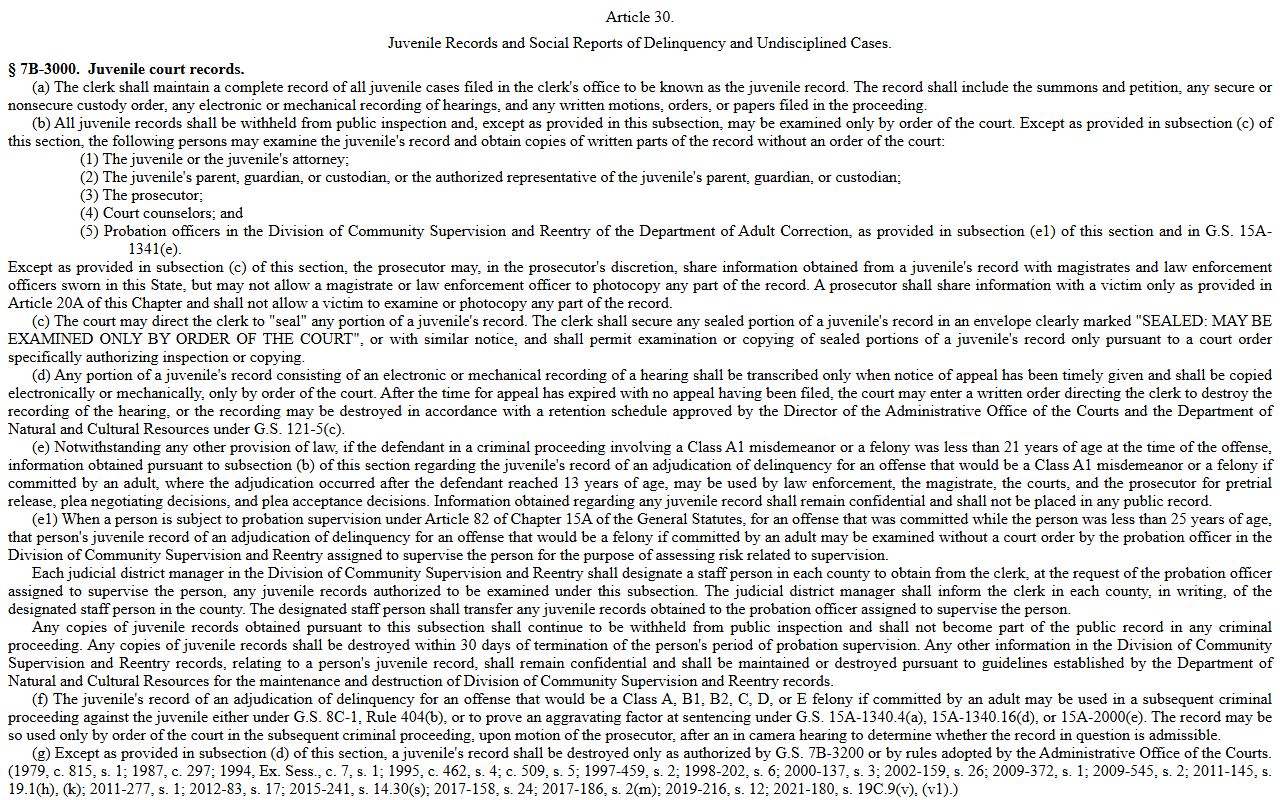
The juvenile statute explains why adult criminal search methods do not apply to juvenile delinquency and undisciplined files.
G.S. 7B-2901 covers abuse, neglect, and dependency records. These records may involve the clerk, judges, and Guardian ad Litem participation, but the public cannot inspect them like ordinary civil files.
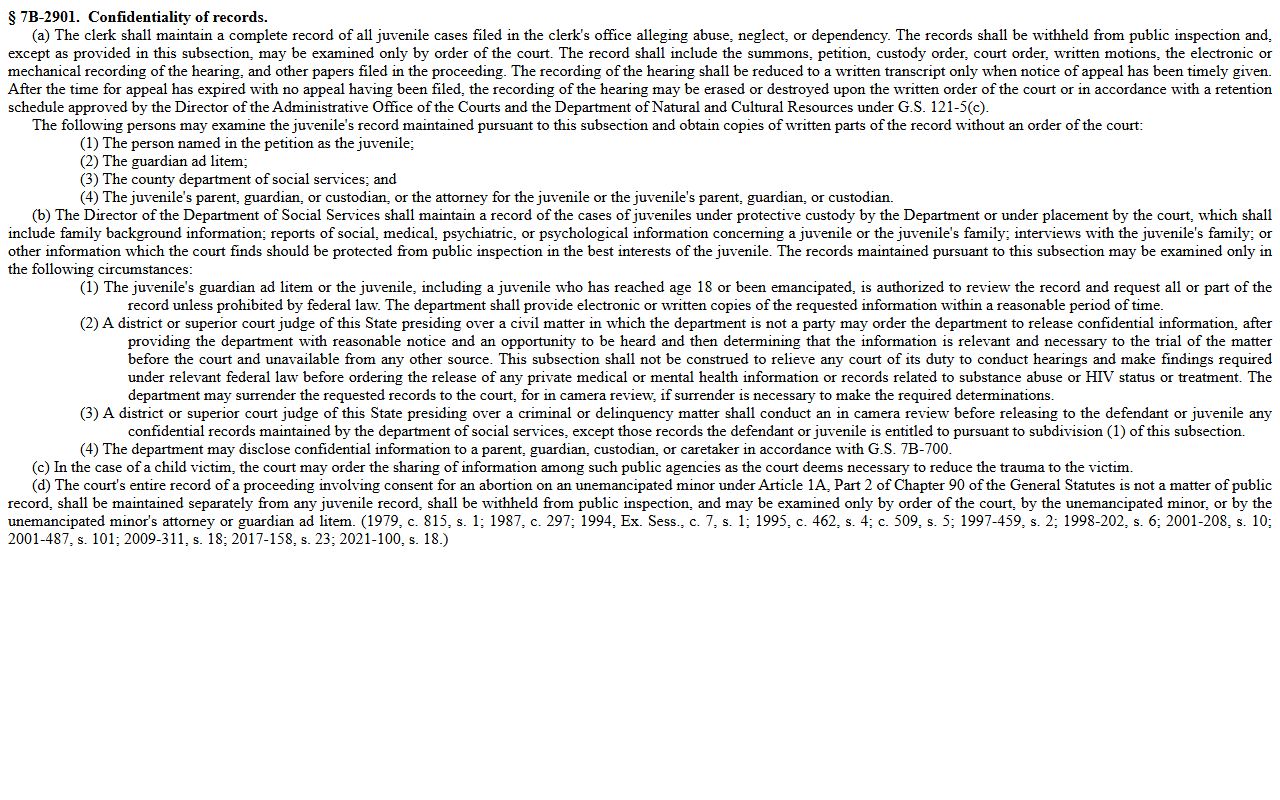
That restriction protects sensitive juvenile and family information while preserving the clerk's role as the official court-record custodian.
Online and Counter Access
Yancey County joined eCourts Track 9 on July 21, 2025. Since that launch, public users can begin many searches in the NC eCourts Portal, use Smart Search for public case information, use Search Hearings for court dates, and use the judgment portal for judgment index work. Portal access is still not the same as a complete paper file. NC Courts directs users to the clerk in the filing county for case documents and certified copies.
NCAOC public-record requests are limited in this context. The Judicial Branch public-record request route is for administrative records held by the Judicial Branch, not for county case files, case information, or vital certificates. For a Yancey County court file, the correct path is Portal or terminal search first, then the Yancey County Clerk of Superior Court for paper records, copies, and certification.